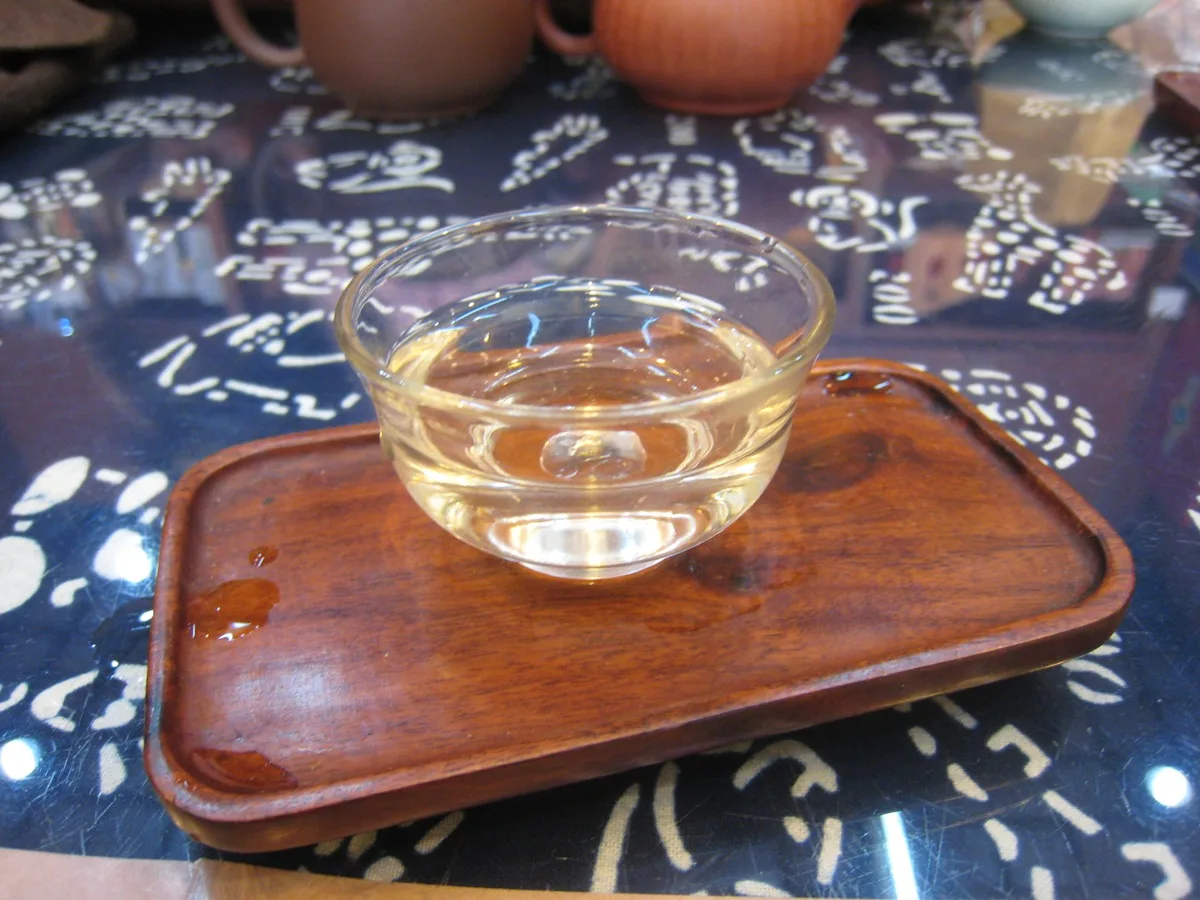
A fair supplier comparison uses coded samples, one written preparation protocol, the same water and equipment, independent scoring, defined descriptor anchors and a decision rule fixed before anyone sees the supplier names. Tea cupping is useful for comparing sensory differences and commercial fit. It cannot prove pesticide compliance, composition, authenticity or shipment-wide conformity.
Start with the purchase question, not the scorecard
Only compare teas intended to answer the same question: for example, three Chunmee candidates for one wholesale specification, or a production lot against its sealed approved sample. Mixing different styles, price positions or end uses can produce a neat ranking that has no purchasing meaning.
Write the decision in one sentence before opening the samples: "Select candidates that match reference R-24 for clean aroma, briskness, body and aftertaste, with no critical off-note, then send the qualifying samples to the commercial and analytical review." This prevents a high total score from excusing a disqualifying taint or a poor match to the target market.
Keep five kinds of requirement separate
- Trade reference: customary tasting practice, a grade code or a supplier's description helps communication but is not a complete method.
- Legal requirement: destination food law may control residues, contaminants, hygiene or labelling. A sensory pass is not legal-compliance evidence.
- Voluntary standard: ISO 3103 describes preparation of tea liquor for sensory tests. It becomes controlling only when adopted by law, specification or agreement.
- Buyer specification: the buyer fixes sample identity, preparation, attributes, anchors, acceptance criteria and records.
- Contract requirement: the parties agree which sample and method govern, who may test, and how a difference or rejection will be handled.
Freeze a cupping protocol before the session
The ISO catalogue checked on 6 August 2026 lists ISO 3103:2019, Tea - Preparation of liquor for use in sensory tests, as current after confirmation in 2025. Its public abstract confirms that it specifies a tea-liquor preparation method, but the catalogue page is not the full procedure. Obtain the standard and cite its edition if an ISO-conforming method is required.
A buyer may instead use a house protocol, provided it is precise and never mislabelled as ISO. The example below - 3.0 g tea, 150 mL water, 95 degrees C at pouring and 5:00 minutes - is an editorial example of a controlled internal method, not a quotation from ISO 3103 and not a universal green-tea optimum. Change it for the commercial question if needed, then keep it unchanged across candidates and reruns.
Use this seven-step supplier comparison
- Qualify the samples. Confirm that each sample represents the intended product or lot. Use a comparable pack size and storage history where possible. A beautifully prepared cup cannot repair a biased sample; see the representative bulk tea sampling method.
- Select the reference. Include the sealed approved sample, current purchase or market benchmark when the decision is about matching. Assign it a blind code like every candidate. A hidden duplicate of one sample is useful for checking repeatability.
- Prepare the room and schedule. Remove distracting odours, use stable neutral lighting and identical clean vessels, and limit interruptions. Randomise three-digit codes. Rotate presentation order across assessors so the same tea is not always first or last.
- Brew as one controlled batch. Weigh each portion, measure water, start timers consistently and decant or separate liquor from leaf at the stated time. Record every deviation. If cup A infused 40 seconds longer, rerun it; do not "correct" the score mentally.
- Assess independently. First inspect dry leaf and dry aroma if they are part of the purchase specification. Then evaluate liquor appearance, aroma, taste, mouthfeel, aftertaste and infused leaf in a fixed order. Assessors should write observations before discussing them.
- Review repeatability. Compare the hidden duplicate and any replicated cups. Large within-sample differences call for a rerun or assessor calibration, not a confident supplier ranking. Keep raw individual scores; an average can hide disagreement.
- Apply the prewritten rule. Unblind only after sheets are complete. Classify each candidate as pass, clarify or stop, document the reason and route sensory qualifiers to specification, laboratory, commercial and contract checks.
Build descriptors and scales that people use the same way
ISO 11035:1994, current after confirmation in 2024, supports identifying descriptors and evaluating their intensity to profile and compare products. ISO 4121:2003, current after confirmation in 2023, covers quantitative response scales. The practical lesson is to define what every word and number means before scoring.
For a simple internal sheet, use a six-point intensity scale: 0 absent, 1 trace, 2 slight, 3 clear, 4 strong, 5 dominant. Train assessors with reference examples and short definitions. Record direction as well as intensity: strong astringency may be desirable for one market and unsuitable for another. Keep "intensity" separate from "liking" and "match to target."
ISO 6658:2017, current after confirmation in 2024, distinguishes objective sensory analysis from preference-focused hedonic testing. ISO 8586:2023 addresses selection and training of sensory assessors. A purchasing team does not need to call itself a formal sensory panel, but it should be honest about assessor competence, training and limitations.
Common buyer mistakes
- Letting supplier names, prices or grade claims influence scoring.
- Comparing different leaf weights, water, vessels, temperatures or infusion times.
- Using code 001, 002 and 003 in the supplier's presentation order.
- Discussing aroma or taste before everyone records an independent observation.
- Changing descriptors or acceptance rules after seeing a favoured result.
- Adding all attributes into one total that conceals a critical off-note.
- Confusing a stronger cup with a better or more suitable cup.
- Ranking samples after one cup despite preparation error or panel disagreement.
- Using a pre-contract display sample as proof of the later production lot.
- Treating sensory approval as a substitute for the COA and analytical evidence review.
Practical conclusion
A defensible comparison leaves a traceable chain: purchase question - representative samples - blind codes - fixed preparation - independent descriptors - repeatability check - prewritten decision rule - sealed approved reference - analytical and contract controls. Preserve the raw sheets, code key, protocol version, deviations and retained samples together.
Use the site's shorter bulk green tea sample checklist for the inspection sequence, put the final sensory method into the bulk green tea purchase specification, review Yunjing Tea's sample-to-shipment quality controls, and send the target tea, reference sample and destination requirements when requesting comparison samples.
Sources checked 6 August 2026: ISO 3103:2019, Tea - Preparation of liquor for use in sensory tests (confirmed 2025); ISO 6658:2017, Sensory analysis - Methodology - General guidance (confirmed 2024); ISO 8586:2023, Sensory analysis - Selection and training of sensory assessors; ISO 4121:2003, quantitative response scales (confirmed 2023); and ISO 11035:1994, sensory-profile descriptors (confirmed 2024).