A workable bulk green tea purchase specification tells both parties exactly what product is being bought, how the shipment will be sampled and tested, and what happens if a result is outside the agreed limit. Start with the intended use and destination market, attach an approved reference sample, then write measurable requirements with named methods and acceptance rules. A grade code or a supplier's certificate alone is not enough.
First separate five kinds of requirement
Buyers often combine unlike requirements in one vague sentence such as “41022, EU standard, good quality.” That wording cannot reliably settle a disagreement. Separate the following:
- Trade reference: a commercial name or code such as Chunmee 41022 or Gunpowder 3505. It helps identify a style but does not make every supplier's tea identical. Our green tea grades guide explains how to use codes alongside samples.
- Legal requirement: a mandatory rule in the destination market, including applicable contaminant, pesticide-residue, food-contact, labelling or import requirements. Record the jurisdiction and the rule version checked.
- Voluntary standard: a published technical reference that becomes binding only when the law, buyer specification or contract incorporates it. ISO 11287:2011 is an international green-tea standard; China's GB/T 14456.1-2017 is listed by the national standards platform as a current recommended, rather than mandatory, national standard.
- Buyer specification: your measurable product and service requirements, including tighter limits or different test panels needed for your use.
- Contract requirement: the final obligation accepted by buyer and seller. It should state which document prevails if the purchase order, specification, approved sample and laboratory report differ.
This distinction matters because a voluntary standard can supply terminology or methods, but it does not automatically replace destination law. For example, the European Commission says its pesticides database is an information tool and that official residue rules are published in the Official Journal. Check the legally effective source for the destination on the contract date.
Use this nine-part specification template
Write sensory requirements so another person can repeat them
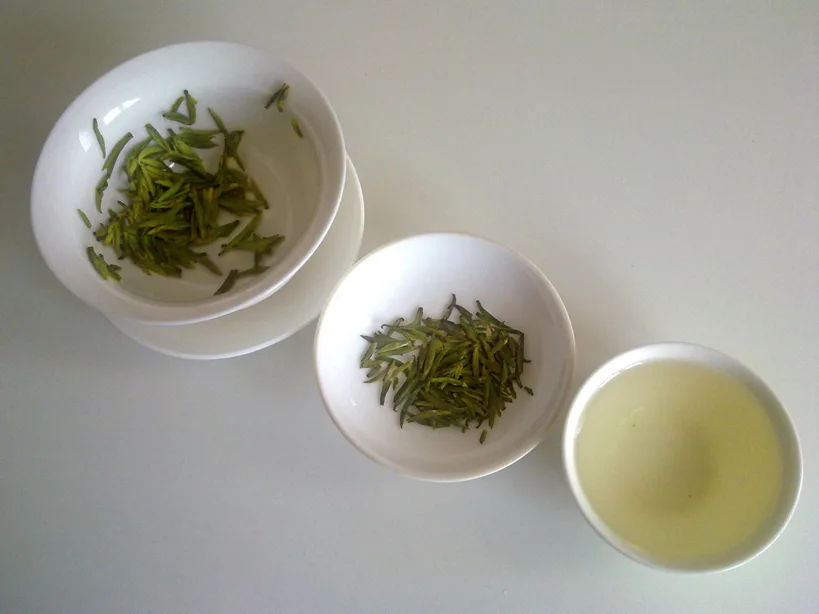
“Fresh taste” or “nice green colour” is too subjective. State the preparation method: sample mass, water volume and quality, temperature, infusion time, vessel, and number of infusions. Then describe acceptable ranges for appearance, aroma, liquor, taste and infused leaf. Link those words to a sealed reference sample identified by code, date and signatures.
The approved sample controls attributes that are difficult to reduce to a number, but it must not replace safety testing. Nor should a small sales sample silently control a shipment if it was not drawn from the contracted lot. Use a pre-shipment sample taken under the agreed plan and compare it with the retained reference. See our guide to evaluating a bulk green tea sample and the site's quality-control checkpoints.
For every laboratory item, specify four things
- Parameter: identify exactly what is measured. “Ash” is ambiguous if total ash, water-soluble ash and acid-insoluble ash are available.
- Limit and unit: write minimum or maximum, the unit, and whether the result is expressed on an as-received or dry-matter basis. A blank such as “moisture: maximum ___%” is safer during negotiation than inventing a number copied from another market.
- Method: cite the agreed edition of the standard or validated laboratory method. ISO maintains separate tea methods for sampling, sample preparation and analytical determinations; naming only the parameter does not ensure comparable results.
- Decision rule: identify the laboratory, measurement-uncertainty treatment if relevant, rounding rule, and whether a failed result triggers retest, rejection or another remedy.
For pesticide residues, do not write only “EU compliant” or “meets destination standard.” Record the market, commodity classification, substances or screening scope, applicable limits, source and check date. On 1 August 2026, the EU Commission database still directed users to the Official Journal as the legally authoritative source. Because limits change, repeat the check when the contract is signed and again before testing if shipment timing is long.
Make sampling part of the purchase control
A precise test limit is weak if the sample is not representative. ISO 1839:1980 applies to tea containers of all sizes and covers sampling, sample packaging, labelling, dispatch and the sampling report. Your contract should identify who samples, how the lot and containers are selected, how increments are combined, how laboratory and referee portions are sealed, and who may witness the work.
Do not let the seller test one convenient bag while the buyer later tests a composite from the whole lot. Those are different sampling frames. Define the lot before sampling and prohibit mixing or substitution after the sample is drawn unless the lot is sampled again.
Connect packing and documents to the same lot
State food-contact inner material, pack style, net weight and tolerance, closure, outer dimensions, marks, pallet status and protection from moisture and odour. ISO 11287 includes packing and marking within its scope, which is a useful reminder that conformity is not only a cup or laboratory result. Match the packing list, certificate of analysis, residue report, lot marks and bill of lading to the same lot identity. Our bulk tea packing guide helps translate the pack into a loading plan.
Common buyer mistakes
- Using a grade code as the complete quality definition.
- Copying chemical limits without the test method, unit or calculation basis.
- Writing “pass all laws” without naming the destination and current rule.
- Approving a cup sample but leaving sampling and lot identity undefined.
- Requesting a broad residue screen without agreeing analytes, reporting limits and decision rules.
- Listing documents without stating when they are due or what happens if they do not match the lot.
- Leaving conflict precedence and remedies until after a dispute.
A practical final check before signing
Ask a colleague who did not draft the specification to answer four questions from the document alone: What exactly is the tea? How will conformity be measured? Who decides pass or fail? What is the remedy? If any answer depends on an unwritten conversation, revise the specification. Then attach the final version and approved sample record to the purchase contract, freeze document revisions, and use the same controls for pre-shipment release.
For a product-specific starting point, compare bulk Chunmee and Gunpowder green tea, then send Yunjing Tea your destination, use, volume and draft specification for review.
Sources checked 1 August 2026: ISO 11287:2011, Green tea — Definition and basic requirements; ISO 1839:1980, Tea — Sampling; SAMR national standards platform, GB/T 14456.1-2017; and European Commission EU Pesticides Database.