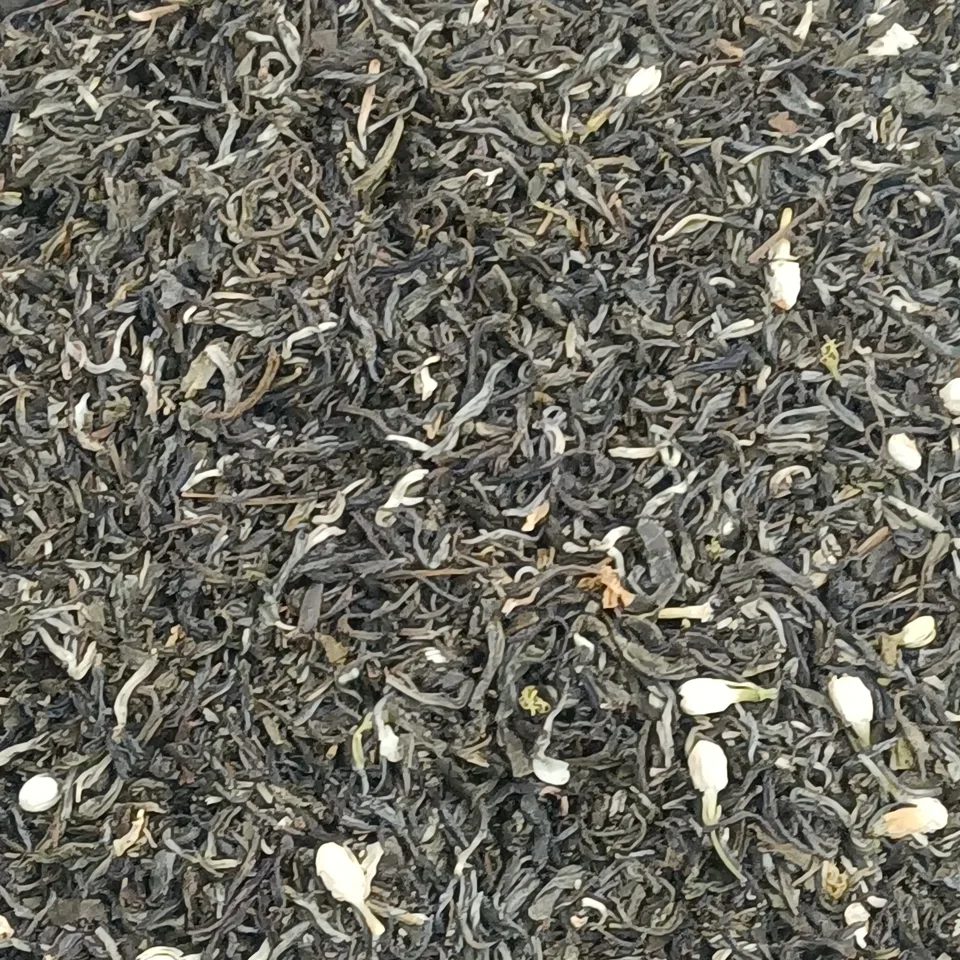
Before approving a flavoured green tea, obtain the exact formula and process, classify every input by function, and translate that information into the destination market's product name, ingredient list, allergen statement and supporting records. “Jasmine tea” can describe tea scented through contact with flowers that are later removed, tea containing visible petals, tea made with a flavour preparation, or combinations of these routes. A matching aroma does not tell a buyer which route was used or what must appear on the finished label.
Separate the commercial name from the actual composition
Start with the tea as sold, not with a familiar name. Record the base tea, retained botanical pieces, flavouring preparations, flavouring substances, carriers, solvents, additives, processing aids and rework. Map the manufacturing flow as well as the bill of materials: a flower used during scenting and removed before packing raises different composition and evidence questions from dried petals intentionally retained in the sale product.
Do not decide the legal declaration from sensory inspection alone. Whether a scenting material, carrier or processing aid must be declared depends on its function, fate in the finished food and the destination rule. Ask the responsible market operator or qualified adviser to classify the real process; do not convert the trade word “natural” into a legal conclusion.
Keep five requirement layers separate
- Legal requirement: the destination's food-name, ingredient, flavouring, additive, allergen and quantitative-declaration rules are binding for products within scope.
- Voluntary standard: Codex labelling texts provide an international reference but do not replace the law of the importing country.
- Trade reference: “jasmine tea,” “flower-scented,” “natural aroma” and “with petals” help describe a commercial concept; they are not complete formulas or universally accepted legal names.
- Buyer specification: the buyer fixes the permitted base tea, inputs, sensory target, visible botanical content, prohibited substitutions, documents and label-data format.
- Contract requirement: the signed agreement makes the approved formula, supplier declarations, artwork, change notice and remedy enforceable between buyer and seller.
Build one composition-to-declaration control sheet
| Control field | Evidence to obtain | Buyer decision |
|---|---|---|
| Base tea | Botanical identity, tea type, grade/style, source and lot-linked specification | Confirm the base named in the formula matches the approved sample and purchase description |
| Flowers, fruit, herbs or spices | Specific common name, plant part, physical form, input percentage and whether retained or removed | Decide whether the material is a visible ingredient, scenting input or another process material under destination law |
| Flavour preparation | Supplier name/code, regulatory status, natural/artificial classification by market, use level and intended food use | Approve the exact preparation and proposed declaration; reject a generic “essence” description |
| Carriers and other constituents | Full qualitative composition, function, finished-product fate and concentration where needed | Determine declaration, additive and allergen consequences rather than assuming every carrier is exempt |
| Allergens and cross-contact | Recipe allergens, constituent allergens, processing aids, cross-contact assessment and market-specific statement | Verify the label and controls against the destination list; do not hide allergens inside confidential flavour data |
| Product name and emphasis | Front name, pictures, flavour claims and highlighted ingredients | Check whether wording accurately describes the food and whether a quantitative ingredient declaration is triggered |
| Change control | Formula revision, flavour code, supplier/site, effective lot and approval history | Place changed lots on hold until composition, legality, sample and artwork effects are reviewed |
Use an eight-step approval method
- Freeze the intended market and sales format. Record the importing country, legal entity responsible for the consumer label, bulk versus retail route, intended user and languages. The same product can need different descriptions in the EU and United States. A supplier's export label is evidence input, not automatic approval for every market.
- Classify the physical product. State whether it is plain tea, tea scented by contact with flowers, a mixture retaining flowers or other botanicals, tea with added flavouring, or a combination. Photograph the dry product and infused material, but use process and formula records—not appearance—to make the classification. Link the result to the site's green tea authenticity claim map.
- Obtain a controlled formula and process flow. Require ingredient names, supplier codes, percentages or confidential ranges sufficient for legal review, processing sequence, additions, removals, rework and final yield. If a flavour house will not disclose proprietary proportions, it should still provide the qualitative, regulatory and allergen information needed by the food business customer. A certificate saying only “food grade” cannot support a label.
- Qualify every flavouring for the destination. For the EU, Regulation (EC) No 1334/2008 defines flavouring categories, sets conditions of use and controls the term “natural.” Article 16 allows a named-source “natural X flavouring” only when the flavouring component comes exclusively or at least 95% by weight from that named source; other wording applies when that condition is not met. The current Union list and use conditions must still be checked for the actual components. U.S. definitions and characterising-flavour statements follow a different system in 21 CFR 101.22. Never translate one market's supplier declaration word-for-word into another market's legal name.
- Screen carriers, additives and allergens. Ask what accompanies the flavour into the tea and what function remains in the finished product. EU Regulation 1169/2011 Article 20 contains limited ingredient-list omissions for qualifying carry-over additives, processing aids and carriers, but Article 21 allergen rules apply separately. Codex likewise distinguishes carry-over and processing-aid situations while protecting allergen declarations. Obtain enough evidence to assess the actual material; confidentiality between suppliers does not cancel the downstream operator's duty to label lawfully.
- Draft the name and ingredient list together. Under the EU food-information regulation, ingredients are generally listed in descending order of weight at use; Annex VII Part D governs the designation of flavourings, and Article 22 with Annex VIII controls when an emphasized or characterising ingredient needs a quantity. The U.S. permits certain collective declarations such as “natural flavor” or “artificial flavor,” while 21 CFR 101.22 adds front-panel rules when a characterising flavour is represented. Codex CXS 1-1985 is a useful trade reference requiring a truthful food name and, except for single-ingredient foods, a descending ingredient list. These frameworks are not interchangeable.
- Verify the first commercial lot. Compare the formula revision, material codes and actual additions with the approved dossier; cup against the approved sample under a controlled method; inspect visible botanical content and pack marks; and retain lot-linked samples and records. Analytical testing may investigate a defined risk, but a routine COA cannot reconstruct a proprietary flavour formula or prove that no undeclared carrier was used. Use a representative lot sample and read what a green tea COA can and cannot prove.
- Prewrite hold and change rules. Use pass only when the composition dossier, market assessment, sample and artwork agree; clarify/hold when a component, legal category, allergen answer or quantity is incomplete; and fail when the lot contradicts the approved formula or proposed label. Require prior notice for changes to the base tea, botanical input, flavour code or supplier, carrier, use level, process, site or artwork. Apply the site's supplier change-control plan before releasing the affected lot.
Common buyer mistakes
- Treating all jasmine aroma as proof of one traditional scenting process.
- Listing only green tea and ignoring retained flowers, flavour preparations or other actual inputs.
- Calling a flavour “natural jasmine” without market-specific composition evidence for that wording.
- Assuming a flavour carrier or processing aid is always exempt from declaration.
- Failing to obtain allergen information because the flavour formula is confidential.
- Copying an EU ingredient name onto a U.S. label, or the reverse.
- Showing flowers or fruit prominently without checking name and quantitative-declaration consequences.
- Approving a sample while leaving the flavour supplier code and use level uncontrolled.
- Relying on a residue or microbiology COA as proof of the complete formula.
- Allowing a replacement flavour or carrier after artwork approval without re-review.
Practical conclusion
The workable sequence is market - product route - formula - component classification - allergen review - label draft - lot verification - change control. Put the approved formula revision, ingredient evidence and artwork beside the bulk green tea purchase specification, and connect every finished pack to the lot-control system. To discuss a proposed plain or further-processed tea input, send the destination, product form, intended label name, volume and required evidence. Final consumer-labelling approval remains with the responsible market operator and qualified regulatory adviser.
Sources checked 4 September 2026: the EU's current 1 April 2025 consolidated Regulation (EU) No 1169/2011 on food information, especially Articles 17-22 and Annexes II, VII and VIII; the current 16 February 2026 consolidated Regulation (EC) No 1334/2008 on flavourings, including Article 16; Codex CXS 1-1985, current 2026 text; and the U.S. 21 CFR 101.22, eCFR current through 2 September 2026. Codex is an international reference; EU and U.S. examples apply only within their respective legal scopes. Check the destination's current rules and the actual formulation before approving a label.